专题

【埃及金字塔报】Expanding cooperation with the BRICS 发布日期: 2026年09月14日 来源:埃及金字塔报
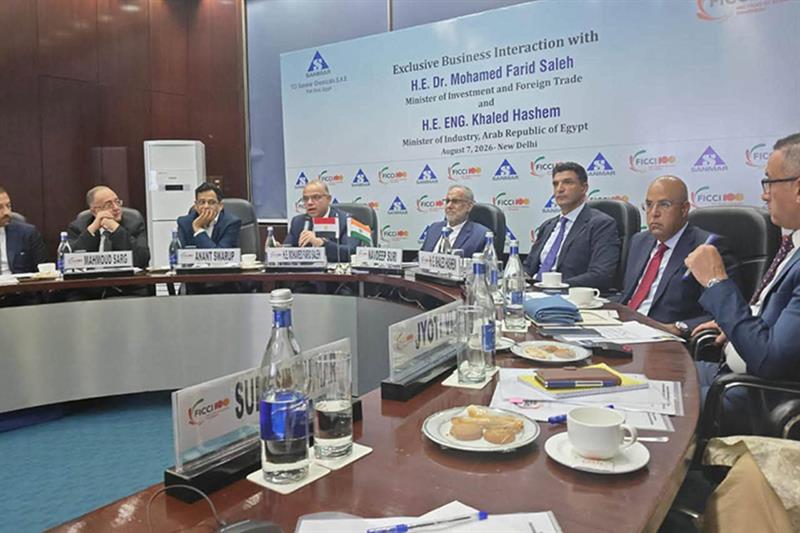
Minister of Investment and Foreign Trade Mohamed Farid Saleh and Industry Minister Khaled Hashem participated in the 16th meeting of the BRICS trade and industry ministers, which was hosted in the city of Jaipur on 6 and 7 August within the framework of India’s presidency of the group for 2026.
The slogan of the meeting was “Building Resilience, Innovation, Cooperation, and Sustainability”.
The two ministers’ participation reflected the government’s keenness to maximise the benefits from Egypt’s membership in the BRICS group, especially in the light of the remarkable increase in the volume of trade exchanges between Egypt and the bloc’s countries.
These increased to $53.5 billion in 2025, up from $45 billion in 2024, with a robust growth rate of about 18.8 per cent.
Egyptian exports to the bloc also increased to almost $14 billion in 2025, up from around $9.5 billion in 2024, while imports amounted to around $40 billion, up from $35.5 billion during 2024.
Saleh indicated that Egypt’s keenness to actively participate in the BRICS meeting this year was due to its desire to enhance economic, trade, and investment cooperation with other member countries and to transform multilateral cooperation frameworks into practical opportunities for Egyptian companies, thereby supporting increased exports, attracting quality investments, enhancing industrial integration, and raising the competitiveness of the Egyptian economy.
Saleh and Hashem’s agenda included meetings with India’s Minister of Commerce and Industry Piyush Goyal, Brazil’s Minister of Development and Industry, Trade, and Services Marcio Fernando Elias Rosa, China’s Deputy Minister of Commerce Li Cheng Gang, and Russia’s Deputy Minister of Economic Development Vladimir Ilyichev.
Hashem said that his and Saleh’s talks with their counterparts in India, Brazil, China, and Russia had focused on addressing ways to enhance trade, investment, and industrial cooperation, increase the volume of trade exchange, attract investments, and launch joint projects that could benefit from the comparative advantages of the three countries, in order to support development efforts and enhance the integration of the Egyptian economy into global value and supply chains.
“As the value of Egypt’s trade with the BRICS countries is about to hit a record $54 billion, it was important to deepen our partnerships with these countries to boost our industrial exports and attract investments,” Hashem said, indicating that “countries like India, Brazil, China, Russia, and South Africa are very important markets for Egyptian exports and industrial cooperation.”
Egypt officially joined the BRICS group of countries in January 2024, with the bloc now including 11 states — Russia, Brazil, India, South Africa, Egypt, Saudi Arabia, the UAE, Ethiopia, Iran, and Indonesia.
In his meeting with Goyal, Hashem discussed the possibility of launching a platform for industrial integration between the two countries, increasing Indian investments in Egyptian markets, and benefiting from the high industrial and technological capabilities that India possesses.
Hashem stressed that Egypt and India share many development priorities, foremost among them supporting small and medium-sized enterprises (SMEs), developing rural areas, simplifying industrial procedures, boosting the contributions of industry to growth and employment, deepening local manufacturing, and diversifying supply chains.
According to Hashem, Egypt wants to enhance its position as a centre for manufacturing Indian products directed to Middle Eastern and African markets.
Hashem and Goyal agreed to prepare a joint study to identify priority sectors for industrial and investment integration, including in the automotive industry and its components, pharmaceuticals and medical devices, renewable energy, fertilisers, phosphate and mineral-based industries, machinery, equipment, the engineering industries, financial technology, and industries geared towards SMEs.
There would also be enhanced cooperation in digital payments, the expansion of the use of local currencies in settling trade transactions, and preparations for the seventh session of the Egyptian-Indian Joint Trade Committee.
Goyal said there are a lot of similarities between the Egyptian and Indian economies, a fact which helps form the basis for building a long-term strategic partnership.
The talks between Saleh and his Brazilian counterpart Elias Rosa focused on increasing the volume of trade exchanges between the two countries and opening new markets for Egyptian exports to strengthen their economic partnership.
Saleh said the talks included discussing opportunities for cooperation in the fields of energy and biofuels, where the Brazilian side reviewed its expertise in sustainable aviation fuel technologies and biofuels for ships.
The two ministers also discussed a proposal to transform Egypt into a regional hub for supplying ships with low-carbon fuel, especially ships crossing the Suez Canal, which would enhance the competitiveness of the Canal and benefit from its strategic location on global trade routes.
The meeting also addressed investment opportunities in the petroleum, oil, gas, and refinery sectors.
“We agreed there will be meetings with Petrobras [Brazil’s state-owned oil and gas company] and other Brazilian companies to review available investment opportunities in Egypt, in addition to agreeing to organise a joint workshop between APEX [Brazil’s Trade and Investment Promotion Agency] and its Egyptian counterpart to promote investment and reactivate the Egyptian-Brazilian Business Council,” Saleh said.
He said that Egyptian exports to Brazil had increased from $455 million in 2021 to about $1.27 billion during 2025, a growth rate of 179 per cent, while the total volume of bilateral trade had reached about $5.83 billion in the same year. The next stage will witness the diversification of the structure of intra-regional trade, an increase in value-added exports, and the promotion of joint investments, he said.
The Brazilian minister affirmed that his country views Egypt as an important partner and gateway to Africa and said that Brazil wants to serve as a gateway for Egypt to South American markets.
In his meeting with Chinese Minister Li Cheng Gang, Saleh presented ways to enhance trade and investment cooperation between the two countries, deepen their economic partnership, and increase the access of Egyptian exports to the Chinese market.
There were also preparations for the upcoming visit of Chinese President Xi Jinping to Egypt, which is expected to see the signing of a number of memoranda of understanding to enhance economic cooperation.
The two ministers also discussed ways in which Egypt could benefit from China’s initiative for full customs exemptions on imports from African countries with which it has diplomatic relations, in addition to strengthening cooperation within the framework of the African Continental Free Trade Area Agreement (AfcFTA) and encouraging Egyptian companies to participate in the China International Fair for Investment and Trade (CIFIT).
China is continuing to support Egypt’s participation in the China International Import Expo (CIIE) and the Export to China initiative, which contributes to increasing the access of Egyptian products to the Chinese market.
The discussions addressed opportunities for cooperation with Chinese companies in streamlining Egyptian factories, deepening local manufacturing, and leveraging the Misr Spinning and Weaving Company development project in Mahalla Al-Kubra. The Egyptian Sovereign Fund also expressed its readiness to support joint investment projects.
Saleh confirmed that bilateral trade between Egypt and China reached approximately $19.5 billion in 2025, noting that the next phase aims to increase Egyptian value-added exports, attract more Chinese investments, and enhance integration in supply chains.
In another meeting, Saleh stressed the importance of deepening the economic partnership between Egypt and Russia. This came during his meeting with Russian Deputy Minister of Economic Development Vladimir Ilyichev to discuss expanding economic and trade ties between the two countries under the BRICS framework.
Saleh highlighted the positive trade growth between the two countries, with bilateral trade volumes reaching nearly $5.7 billion in 2025. He noted Egyptian exports to Russia had increased by around 67 per cent from $485 million in 2021 to $811 million in 2025 and stressed efforts to increase Egyptian market access and joint investments.
The discussion between Saleh and Ilyichev focused on cooperation in the grain trade, supply chains, and accelerating the full implementation of the Russian Industrial Zone project in Egypt to attract investment and transfer technology.
Saleh expressed Egypt’s desire to host the 16th Joint Egyptian-Russian Committee meeting in Cairo in 2027 to boost cooperation across key sectors including trade, energy, agriculture, and tourism.
The meeting also covered facilitating business travel, with Saleh urging Russia to streamline entry visas for Egyptian business leaders to support direct investment.
中国国际进口博览局(以下简称“进口博览局”)非以营利为目的引用或转载媒体报道,相关行为旨在促进信息共享,不构成对原刊发内容真实性、准确性及合法性的担保或官方立场背书。本网站转载内容的著作权及法律责任均归属于原刊发媒体及作者。
如任何单位或个人认为本网站转载的文章侵犯其合法权益,请及时向我们提出书面意见并提供相关证明材料和理由,我们将在收到上述文件后及时对相关内容进行删除、修正标注或采取其他妥善的处理措施。
引用或转载内容所涉及的信息可能存在时效性差异,用户应对所载信息的准确性和完整性进行独立判断。本网站不承担用户就使用或未能使用本网站所载信息或链接所引致的任何直接、间接、附带、从属、特殊、惩罚性或惩戒性的损害赔偿责任。
进口博览局始终尊重知识产权,致力于在合法合规的框架内提供优质的内容服务。