News

CIIE Stories | World Openness Report: The More Open, The More Developed Release date: 2025-12-31 Source:China International Import Expo Bureau
"It's making very good progress. I look forward to seeing it every year, because it really doesn't have a competitor on that," Christopher Pissarides, Nobel laureate in economics, remarked on the World Openness Report released annually at the Hongqiao International Economic Forum (HQF) during the China International Import Expo (CIIE).
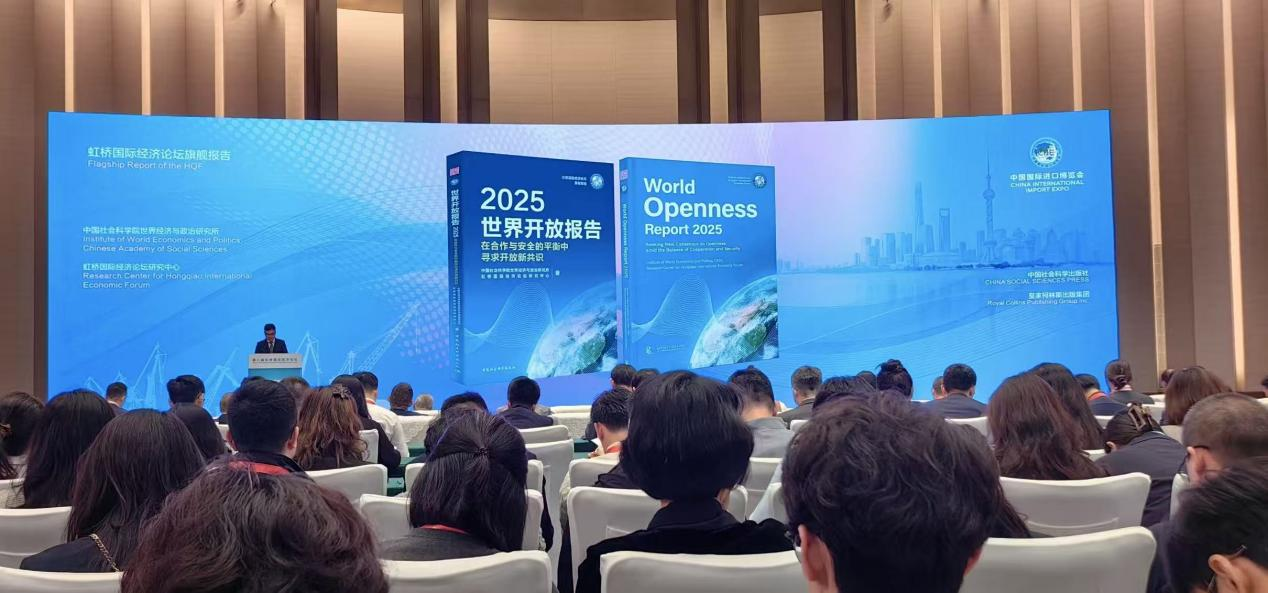
The World Openness Report 2025 was unveiled at the HQF. Source: the Institute of World Economics and Politics, Chinese Academy of Social Sciences
Debuting at the 4th HQF, which was held in tandem with the 4th CIIE, this flagship report was jointly compiled by the Institute of World Economics and Politics (IWEP), Chinese Academy of Social Sciences (CASS), and Research Center for the HQF.
Professor Fu Li, Director of the Institute for World Economy at the Chinese Academy of International Trade and Economic Cooperation (CAITEC), describes the synergy between the Report and the CIIE as a "two-way endeavor". Over five years, the Report and the expo have grown together, witnessing the ups and downs of global openness while documenting China's unwavering commitment to opening its doors wider.
Transforming from the Index to the Report
Since the 2008 global financial crisis, the pace of global economic growth has noticeably slowed. What is the current state of and the trend in world openness? What are the hot topics on opening-up? What are the successful practices on opening-up? To answer these questions, the World Openness Report was created.
The Report is structured in three parts: the World Openness Index, World Openness Hotspots, and Best Practices in Opening-up. Its development was not an instantaneous event, but rather a journey of evolution from a single index into the comprehensive Report we see today.
According to Liu Shiguo, Senior Research Fellow at IWEP, the initial concept was to develop an index to gauge the cross-border openness of major economies. However, it became increasingly apparent that a single index could not adequately meet the diverse demands of governments, international organizations, and academic institutes.
The Report therefore expanded its scope beyond the index, not only to investigate cutting-edge topics, uncover new drivers of openness, and widen avenues for international cooperation, but also to systematically review China’s practice of opening-up, with the aim of sharing its experience globally.
As Prof. Fu noted, the distinct value of the Report lies in its systematic analysis of the theory on and practice in global openness — a perspective uniquely offered by Chinese think tanks and scholars. This endeavor not only fills a critical theoretical void but also reflects China’s intellectual self-assurance and cultural confidence.
“Openness and development are mutually reinforcing. A high degree of openness invariably catalyzes high-quality development. In this spirit, we look forward to sharing the outcomes and insights from China's opening-up globally. The CIIE represents an exemplary practice in advancing the Global Development Initiative," Prof. Fu said.
A perfect match of concept and platform
The HQF, whcih was held in tandem with the CIIE, chose as the Report's release platform evolved into a deliberate strategy. It was in 2021 that the team concluded that a partnership with a influential forum or international body was imperative to enhance the Report's academic, policy, and practical influence. After considerable deliberation, the HQF was designated as the annual venue, thus utilizing the CIIE's international platform for effective global dissemination.
Observing top-tier international forums—such as the Boao Forum for Asia with its Asian Economic Outlook and the Davos World Economic Forum with its Global Competitiveness Report—Prof. Fu argues that the HQF, which champions the theme of openness, needs a flagship report of its own to establish its thought leadership and solidify its global standing.
This choice proved wise. Prof. Fu noted that the CIIE, as the world's first national-level expo themed on imports, vividly embodies China's commitment to openness. Releasing the World Openness Report here at the HQF held in tandem with achieves a perfect match between an idea and a platform.
Cross-border idea exchanges
The international profile of the Report has been significantly elevated over its five-year history. This growth is evidenced by a striking evolution in participation: from a single foreign expert in 2021 to a cohort comprising 60 percent international attendees in 2024. This group has also evolved beyond scholars alone to now feature senior officials from international organizations and professors from foreign think tanks.
In 2025, the Report made four major breakthroughs that significantly enhanced its international reach and authority. For the first time, a Nobel Laureate in Economics led a special chapter, and an initial partnership was formed with the United Nations Industrial Development Organization, greatly increasing the Report's global influence.
The depth of openness measurement was expanded, with the World Openness Index now covering 35 years instead of 17. This extension provides a stronger data foundation for understanding long-term trends in global openness.
The research perspective was also broadened to include cutting-edge topics such as cross-border data flows and green openness. Additionally, the Report introduced the viewpoint of multinational corporations, systematically reviewing the practices of high-level openness.
A special chapter focused on global governance, offering an in-depth analysis of its impact on national openness and exploring practical ways to enhance optimal openness.
The Report's launch has established itself as a vital platform for intellectual dialogue. Prof. Fu reflected that the 2022 event saw experts advocating for China to pursue autonomous opening-up and unilateral opening-up, triggering lively debates. "The Report was crucial," she stated, "serving as an intellectual sparkplug that prompted deep reflection among experts and the audience alike."
Seeking common ground amid differences
The Report's rising profile and international influence have not been without their debates. A significant philosophical disagreement arose during the index design, with several experts critiquing the weight of economic dimension close to 80 percent. They argued that cultural openness forms the bedrock of true integration and should therefore carry more substantial weight. In parallel, other advisors recommended a more proactive narrative strategy to forge wider consensus.
In response, the team adhered to its original mandate, guided by the principle of forging the broadest possible consensus on openness. This commitment to finding common ground is the core value the Report promotes via the CIIE, a philosophy that resonates deeply with the HQF's ethos of open dialogue and mutual gain.
The alliance between the World Openness Report and the CIIE offers both a benchmark for openness and a unifying force to propel it. Prof. Liu described the Report as a global public good that crystallizes the demands of the global majority for openness. He noted, however, that the journey to build wide consensus and effectively foster global cooperation is far from over. "But we are determined," he pledged, "to steadfastly uphold this commitment."
Disclaimer
The information in this article is compiled from materials provided by relevant parties participating in the CIIE and media reports, with the CIIE Bureau objectively compiling relevant content. The CIIE Bureau does not take responsibility for disputes or losses arising from the following circumstances: deviations in expression due to outdated information updates; readers' subjective judgments or actions based on this article; unauthorized alteration or dissemination of the content by third parties.