News

The eighth HQF丨World Openness Report 2025 and Global Consensus Release date: 2025-11-10 Source:China International Import Expo Bureau
President Xi Jinping profoundly pointed out that openness secures progress while seclusion leaves one behind, and openness is a defining hallmark of Chinese-style modernization.
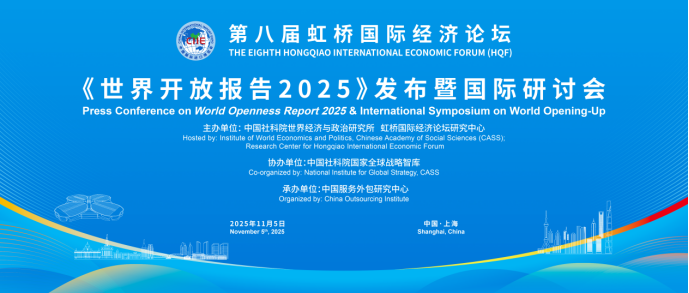
On the afternoon of November 5, 2025, the National Exhibition and Convention Center (Shanghai) successfully hosted the launch ceremony of the World Openness Report 2025 and an accompanying international symposium. As a key parallel session of the 8th Hongqiao International Economic Forum (HQF), the event featured the release of the Forum’s flagship report—the World Openness Report 2025—along with the latest World Openness Index, providing intellectual impetus for advancing an open global economy.
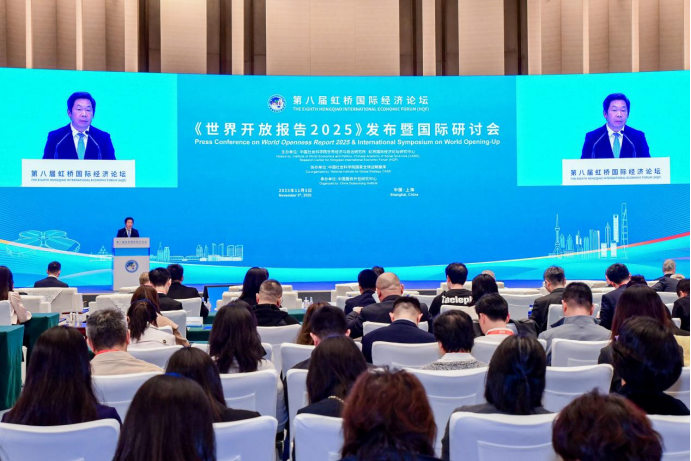
This press conference and symposium is jointly hosted by the Institute of World Economics and Politics (IWEP) of the Chinese Academy of Social Sciences (CASS) and Research Center for the HQF, co-organized by the National Institute for Global Strategy of the CASS, and organized by the China Outsourcing Institute.
The event features four panels: Keynote Speeches, Press Conference on World Openness Report, Business Leader's View on Openness, and Experts' Views on World Openness, forming a multi-level and multi-dimensional in-depth exchange.
The Keynote Speeches panel featured addresses from a diverse group of domestic and international leaders. Speakers included Mr. Shahin Mustafayev, Deputy Prime Minister of the Republic of Azerbaijan; Mr. LING Ji, Vice Minister of Commerce and Deputy China International Trade Representative; Mr. ZHAO Zhimin, Secretary-General of the CASS, and Ms. SHU Luomei, Director in the Division of Investment and Technology Promotion Offices (ITPOs) and Institutional Partnerships, UNIDO.
In their remarks, they praised the academic value and practical significance of the World Openness Report 2025 and the World Openness Index, sharing profound insights on openness theory, policy, and practice. They also expressed their hope that the Report would continue to play a positive role in advancing an open world economy.
Mr. LIAO Fan, head of the research team for the World Openness Report 2025 and director of the IWEP, and Mr. WANG Xuekun, Director of Research Center for HQF, jointly introduced the core content and highlights of the Report.
The Report is presented in twelve chapters across three thematic sections: World Openness Trends, Key Openness Topics, and Global Best Practices. Anchored by its mission to "build an open world economy", the Report, themed "Seeking a New Openness Consensus in a World Balancing Cooperation and Security", presents a landmark 35-year historical perspective by extending the World Openness Index time series back to 1990 for the first time.
The Report delves into cutting-edge topics—from cross-border data flows and global industrial chains to industrialization in the Global South. It probes the dialectic between global good governance and consensual openness, while also showcasing China's own opening-up as a catalyst for new win-win cooperation.
The Report systematically reviews China's contributions to global openness, embodied in the Belt and Road Initiative, the China International Import Expo (CIIE), and the mutually beneficial dynamics between multinational corporations and China. These cases demonstrate how China's sustained opening-up not only injects new momentum into economic globalization but also serves as living proof that "Greater openness fuels development, and greater development, in turn, fuels further openness." In a world of profound uncertainties, this Report offers clarity and direction. Using the 15th Five-Year Plan as a launchpad, it presents China's vision as a beacon for stable and sustainable global development.
Having been launched at five consecutive CIIEs—a period marked by continuous innovation and breakthroughs in openness theory and practice—the World Openness Report 2025 culminates in four major advances.
Breakthrough 1: Enhanced International Authority. The Report significantly boosted its global influence by, for the first time, inviting a Nobel Laureate in Economics to lead a dedicated research chapter and establishing initial cooperation with the United Nations Industrial Development Organization (UNIDO).
Breakthrough 2: Deeper Historical Analysis. The time span of the World Openness Index has been more than doubled, extending from 17 to 35 years. This major expansion lays a much stronger foundation for analyzing the long-term trajectory of global openness.
Breakthrough 3: Broadened Research Perspectives. The Report introduces a pioneering multinational corporation perspective to systematically document practical experiences in high-level opening-up, with a dedicated focus on cutting-edge areas like cross-border data flows and green opening-up.
Breakthrough 4: A Dedicated Chapter on Global Governance. The Report introduces a dedicated chapter investigating the impact of global governance on national openness to identify practical pathways for enhancing openness.
In the panel "Business Leaders' View on Openness", representatives from leading enterprises engaged in in-depth discussions on topics including innovation in multinational corporations, green energy cooperation, and cultural exchange. Participants such as Mr. Zafer Unluer, Senior Vice President of Organon, and President of Organon China; Mr. QIAO Yinping, Chief Operating Officer of Shanghai Electric Group; and Mr. Pascal Dasseux, Executive Vice President Hawass and Senior Advisor Asian Affairs Vivendi, shared valuable insights from their practical experiences with opening-up.
At the "Experts Discuss Opening-up" panel, leading international experts reached a consensus that China's role in the world has fundamentally shifted—from "following in the footsteps of others" to "forging a new path." They agreed that as China builds a modern socialist strong nation, it will equally emerge as a strong force for global openness.
The experts further urged all nations to abandon zero-sum thinking at this historical crossroads, strengthen global governance, and advance a more balanced and inclusive model of opening-up to secure a shared future of prosperity and stability.
The panel included Mr. ZHU Min (Member of the Senior Expert Advisory Committee of the China Center for International Economic Exchanges, and Former Deputy Managing Director of the IMF), Mr. Kishore Mahbubani (Former Permanent Representative of Singapore to the United Nations and Distinguished Fellow of the Asia Research Institute at the National University of Singapore), Mr. Hamid Rashid (Former Officer-in-Charge of Global Economic Monitoring Branch of UN, and a former lead author of World Economic Situation and Prospects) , and Mr. ZHANG Yuyan (Academician of the CASS, and Dean of the School of International Politics and Economics, University of CASS).

Since its debut in 2021, the World Openness Report has been released for five consecutive years, with its influence steadily expanding. This symposium successfully established a platform for international dialogue, reinforcing the broad consensus that "openness brings prosperity while seclusion leads to adversity" and "openness benefits the people, advances China’s development, and serves the globe good." This collective spirit channels positive energy into fostering shared development and propels the advancement of an open world economy.
The China International Import Expo Bureau (hereinafter referred to as the "CIIE Bureau") cites or reposts media reports for non-commercial purposes to facilitate information sharing. Such actions do not constitute an endorsement of the accuracy, authenticity, or legality of the original content, nor do they reflect the official stance of the CIIE Bureau. All copyrights and legal responsibilities for the reposted content remain with the original publishers and authors.
If any individual or entity believes that content shared on this website infringes their legitimate rights and interests, please promptly notify us in writing, providing detailed explanations, supporting documentation, and rationale. Upon receiving such materials, we will promptly remove or rectify the disputed content or take other appropriate measures.
Reposted or cited information may be time-sensitive. Users are advised to exercise independent judgment regarding the accuracy and completeness of the content. The CIIE Bureau shall not be liable for any direct, indirect, incidental, consequential, special, punitive, or exemplary damages arising from the use of or inability to use the information or links provided on this website.。
The CIIE Bureau respects intellectual property rights and is committed to delivering high-quality content services within a lawful and compliant framework.