News

The 9th HQF | Parallel Session on“Cross-Border Financial Services DrivingGlobalized Corporate Development”Successfully HeldThe 9th HQF | Parallel Sess Release date: 2026-11-17 Source:CIIE
On the afternoon of November 6, 2026, the Parallel Session on “Cross-Border Financial Services Driving Globalized Corporate Development” of the 9th HongQiao International Economic Forum (HQF) was held at Hall D2, Pavilion 4.2, the National Exhibition and Convention Center (Shanghai). Hosted by Bank of Communications, the Session focused on how cross-border finance can support Chinese enterprises “going global” and international enterprises “coming into China” amid profound changes in global economic and trade patterns. In-depth discussions explored ways to improve the cross-border financial services system and strengthen the resilience of industrial and supply chains.
I. Advancing High-Standard Financial Opening-Up and Exploring Opportunities for Global Business Expansion
The opening remarks and keynote presentations were grounded in China’s strategy of opening up its financial sector and Shanghai’s experience in building an international financial center. The speakers examined the practical financial needs arising as Chinese enterprises enter a new stage of global operations, and called for closer cooperation among government, banks and businesses. They emphasized institutional innovation and upgrades to financial products as vital to supporting the overseas expansion of enterprises in the real economy, setting the tone for the discussions that followed.
In his remarks, HE Qing, Vice Mayor of Shanghai, noted that global economic and trade patterns are undergoing profound adjustments and that global industrial and supply chains are being reconfigured at an accelerating pace. As companies continue to expand overseas, cross-border financial services need to evolve more quickly to provide end-to-end support for their global operations. Shanghai will continue to support China’s broader opening-up agenda and accelerate efforts to build a strategic hub that coordinates the development of advanced onshore and offshore financial services. The city will continue to improve its institutional framework and support financial institutions of all types and enterprises in the real economy in developing innovative cross-border and offshore financial services. These efforts will help make economic globalization more open, inclusive, broadly beneficial, balanced and conducive to shared gains.
REN Deqi, Chairman of Bank of Communications, said that the bank, as the only major state-owned commercial bank headquartered in Shanghai, has long been committed to serving national strategies. The bank makes full use of its advantages in Shanghai, its offshore banking license and its five-in-one account system. To meet companies’ needs in cross-border payments and settlement, overseas financing, global treasury management, compliance and risk management, the bank continues to innovate in cross-border finance, expand the use of the renminbi in cross-border transactions and develop digital platforms, including “BOCOM Trade Link”, its platform for shipping and trade. These efforts strengthen the bank’s ability to deliver integrated, digital and comprehensive cross-border financial services.
Keynote addresses were delivered by FENG Xuguang (Vice Chairman of the Shanghai Federation of Industry and Commerce and Vice President of the Shanghai General Chamber of Commerce), ZHANG Fan (Member of the Standing Committee of the CPC Committee and Deputy General Manager of China Electrical Equipment Group Co., Ltd.), and James J. Heckman (Nobel laureate in economics). They shared insights on the financial needs of private enterprises expanding overseas, industry-finance collaboration at centrally administered state-owned enterprises, technological changes in global cross-border payments, and risk management.
II. Several Innovations Make Their Debut
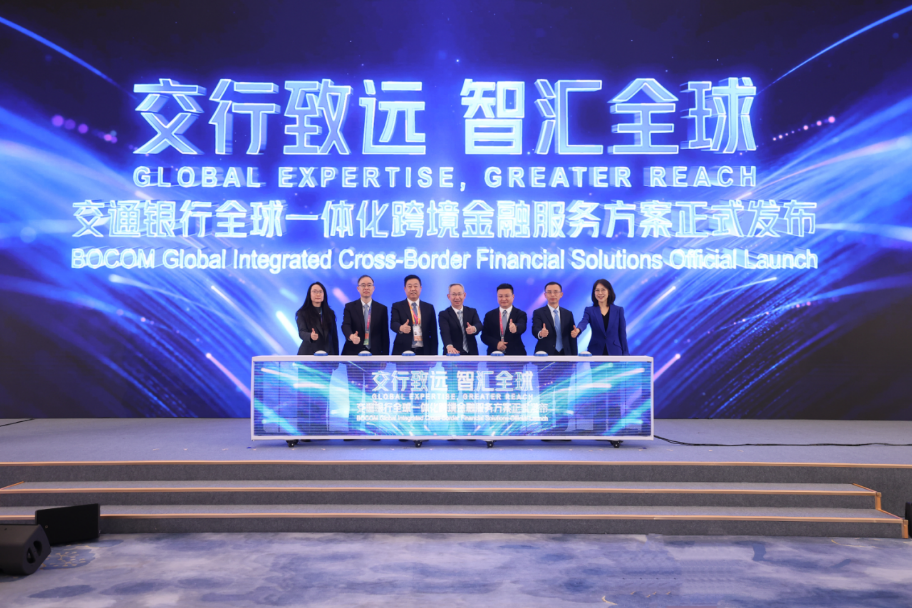
At the session, YANG Tao, Executive Vice President of Bank of Communications, unveiled “Global Expertise, Greater Reach — BOCOM Global Integrated Cross-Border Financial Solutions” and explained in detail how it works. Designed to meet the needs of companies operating globally, the solution is built around the 5C service framework. It draws on BOCOM’s digital platforms, including “BOCOM Trade Link”, its platform for shipping and trade, as well as global treasury management, a mix of investment and financing instruments, and collaboration across its service ecosystem. Its five areas are trade facilitation, access to and movement of funds, account connectivity, smarter business operations, and BOCOM’s service ecosystem. It combines financial resources in China and abroad with the capabilities of global partners to provide companies with integrated, comprehensive cross-border financial services across the full business lifecycle. The launch ceremony for the “Global Connectivity for Opening-up” and Bank-Enterprise Cooperation initiative was held at the same time. TAN Guosheng (General Manager and Co-CEO of United Imaging Healthcare), Saleh Al Khabti (Executive Vice President and Chair of China Operations at ACWA), and Bruno Sales (Chief Financial Officer of Vale China) shared their experiences in global operations and examples of cooperation with Bank of Communications.
III. Exploring New Trends in Chinese Enterprises’ Overseas Expansion and Cross-Border Financial Services Through Multi-Stakeholder Dialogue
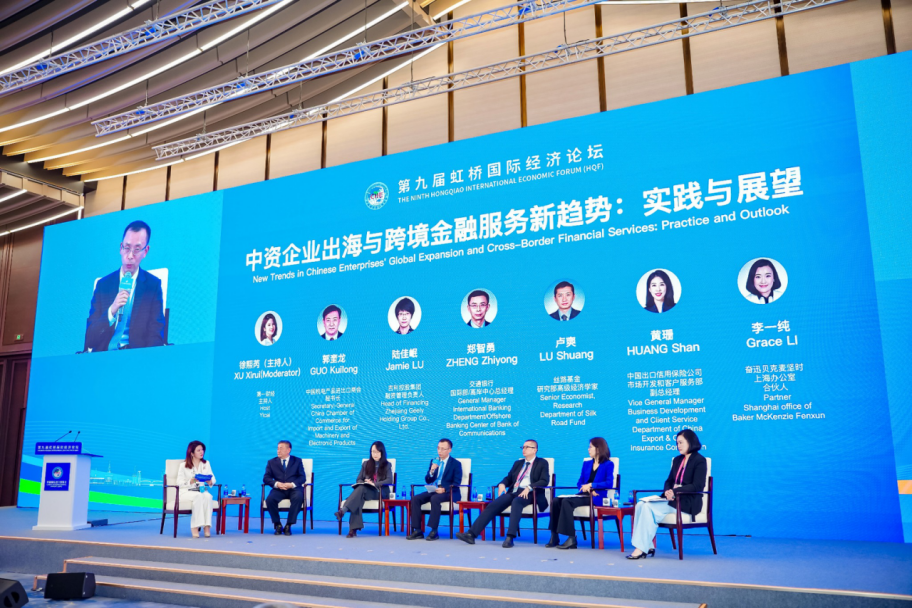
The panel discussion, themed “New Trends in Chinese Enterprises’ Overseas Expansion and Cross-Border Financial Services: Practice and Outlook,” took place against the backdrop of the regionalization, diversification and green transition of global industrial and supply chains. Acknowledging both the opportunities and risks associated with overseas expansion, participants exchanged views on evolving patterns of corporate globalization, innovation in cross-border financial products, end-to-end risk prevention and control, and collaboration across institutions and service ecosystems. They also explored practical ways for banks, insurers, equity investors, industry associations and law firms to work together in supporting the overseas expansion of enterprises in the real economy.
The roundtable brought together GUO Kuilong, Secretary-General of the China Chamber of Commerce for Import and Export of Machinery and Electronic Products; ZHENG Zhiyong, General Manager of the International Banking Department/Offshore Banking Center of Bank of Communications; HUANG Shan, Vice General Manager of the Business Development and Client Service Department of China Export & Credit Insurance Corporation (SINOSURE); and Grace LI, Partner in the Shanghai office of Baker McKenzie FenXun. The speakers discussed Chinese enterprises’ overseas business practices, the evolution of cross-border financial services, risk prevention in overseas operations, and coordinated support from multiple institutions.
Participants agreed that Chinese enterprises’ overseas expansion has progressed from trade in goods to a “Global Operations 2.0” phase, characterized by diversified market presence, localized operations, and green and digital transformation. Compliance and risk management have become significantly more important. Enterprises should prepare for worst-case scenarios, adhere to the principle of risk neutrality, and pay close attention to overseas legal, tax, exchange-rate and supply-chain-related compliance risks. Professional advisers should be brought in early during project planning. Financial institutions, for their part, should move beyond standalone product offerings and build coordinated service ecosystems by bringing together policy resources, capital, legal expertise and risk early-warning capabilities. In this way, they can shift from supplying capital to providing integrated support that combines financing with expertise, helping Chinese enterprises achieve stable and sustainable growth overseas.
The Session was attended by representatives from government departments in China and abroad, industry associations and chambers of commerce, state-owned and private-sector enterprises in the real economy, financial institutions, think tanks and law firms, as well as members of the media.
The China International Import Expo Bureau (hereinafter referred to as the "CIIE Bureau") cites or reposts media reports for non-commercial purposes to facilitate information sharing. Such actions do not constitute an endorsement of the accuracy, authenticity, or legality of the original content, nor do they reflect the official stance of the CIIE Bureau. All copyrights and legal responsibilities for the reposted content remain with the original publishers and authors.
If any individual or entity believes that content shared on this website infringes their legitimate rights and interests, please promptly notify us in writing, providing detailed explanations, supporting documentation, and rationale. Upon receiving such materials, we will promptly remove or rectify the disputed content or take other appropriate measures.
Reposted or cited information may be time-sensitive. Users are advised to exercise independent judgment regarding the accuracy and completeness of the content. The CIIE Bureau shall not be liable for any direct, indirect, incidental, consequential, special, punitive, or exemplary damages arising from the use of or inability to use the information or links provided on this website.。
The CIIE Bureau respects intellectual property rights and is committed to delivering high-quality content services within a lawful and compliant framework.